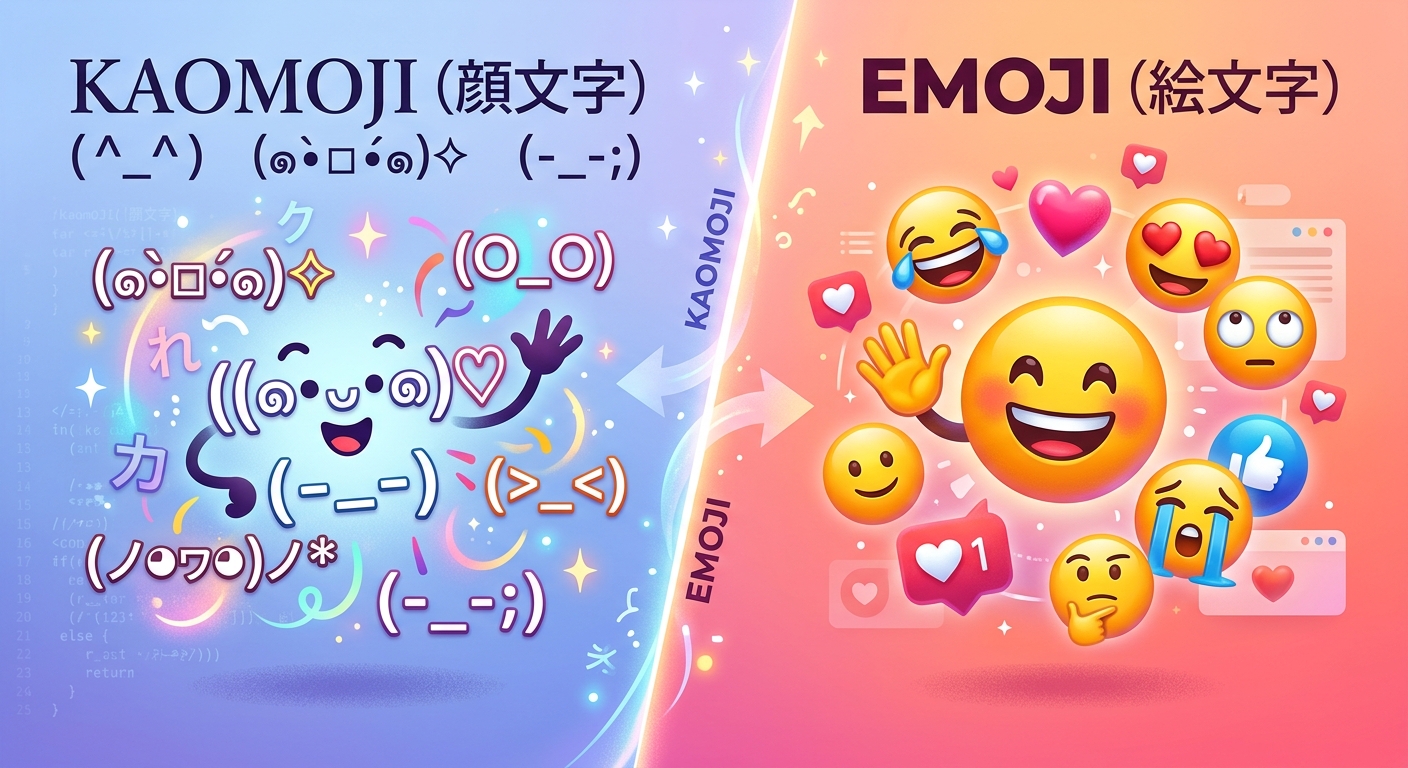
The first time you see (╯°□°)╯︵ ┻━┻, you might think someone's keyboard had a complete breakdown. Then you realize it depicts a person flipping a table in pure frustration, and suddenly it's the most expressive shorthand you've encountered all week. That is kaomoji at work. These Japanese text-based faces have been part of digital culture for decades, and they bring something to online conversation that standard emoji simply cannot replicate.
Kaomoji are expressive faces built entirely from keyboard characters. They read upright, left to right, and carry emotional weight through clever symbol arrangement rather than color or illustration. Emoji, by contrast, are standardized image characters governed by the Unicode Consortium, updated annually and rendered uniquely by each platform. Both forms express feeling within digital text, but they approach that task in fundamentally different ways, each offering something the other cannot quite match.
Where Kaomoji Actually Come From
The story starts in Japan in the early 1980s. Japanese internet users had a practical problem with the ASCII emoticons popular in Western online spaces. Faces like :-) or :-( were designed to be read sideways, which felt unnatural to readers accustomed to upright script conventions. Japanese users responded by building their own alternative: faces that read left to right without tilting your head, using a broader palette of characters than anything Western keyboards offered.
The word kaomoji (顔文字) breaks down into two components. "Kao" means face, and "moji" means character or written letter. The literal meaning is "face character," which describes the form perfectly. Early Japanese bulletin board systems spread these text faces rapidly, and they became a standard part of mobile messaging culture long before smartphones arrived. By the time the rest of the world caught on to emoji, Japan had already spent more than twenty years using expressive text faces in daily communication.
This history matters because kaomoji weren't a novelty item or a passing trend. They were a genuine communication tool born from practical necessity and shaped by a culture that places real value on subtle emotional expression. That foundation gives them a depth that is easy to underestimate at first glance.
The Building Blocks of a Text Face
Understanding how kaomoji are constructed helps explain why they look the way they do. A typical kaomoji has three main zones: the left border, the face or expression at the center, and the right border. The eyes carry most of the emotional signal. Eyebrows, mouths, cheeks, and even body language can be layered on top to deepen the meaning or shift the mood entirely.
The eyes are the most expressive component. A caret symbol like ^ suggests happy squinting. A semicolon hints at awkwardness or nervousness. The capital letter T reads immediately as a tear, making T_T legible as a crying face to anyone who has seen it before. Underscores and periods form mouths. Parentheses and brackets frame the whole expression. Some kaomoji extend outward to include hands, arms, or full body poses constructed around the central face.
What gives this system real range is that it draws from multiple Unicode blocks at once. Latin punctuation, Japanese katakana, box-drawing characters, and mathematical symbols all get recruited into service. The result is a system with effectively unlimited expressive capacity, constrained only by creativity and the width of a message field.
Kaomoji vs. Emoji: How the Two Systems Compare
| Feature | Kaomoji | Emoji |
|---|---|---|
| Origin | Japan, 1980s online communities | Japan, 1999 mobile internet (NTT DoCoMo) |
| Structure | Multiple characters combined into a sequence | Single Unicode code point per character |
| Reading orientation | Upright, left to right | No orientation needed; single glyph |
| Platform rendering | Consistent as plain text across platforms | Varies by operating system and app |
| Customization | Unlimited variation; user-created freely | Fixed set, updated by committee each year |
| Emotional nuance | High; achieved through character arrangement | Moderate; tied to illustrated facial design |
| Discoverability | Requires browsing or copying sequences | Searchable in built-in keyboard pickers |
How Emoji Became a Global Communication Standard
Emoji share a Japanese origin with kaomoji, though the two systems developed along entirely separate tracks. Designer Shigetaka Kurita created the first emoji set in 1999 for NTT DoCoMo's i-mode mobile internet platform. Those original 176 designs were small, pixelated icons with a practical purpose: make mobile messaging faster and more expressive without eating through character limits.
The global spread came when the Unicode Consortium adopted emoji as a formal standard, and Apple and Google built native support into their mobile operating systems. From that point, emoji became a genuinely universal visual language used across virtually every digital platform. The full emoji reference now covers more than three thousand characters, with new additions reviewed and released on an annual cycle. That standardization is what lets a thumbs-up typed on an iPhone appear legible on a Samsung device or a Windows desktop, at least in principle.
The "in principle" qualifier matters. Because emoji are rendered as images rather than plain text, each platform draws its own version of the same character. The result is that a single emoji can look noticeably different depending on where it lands, and that visual gap carries real consequences for meaning.
The Rendering Gap That Kaomoji Simply Don't Have
This is a structural advantage of kaomoji that rarely gets the attention it deserves. Because kaomoji are plain text built from Unicode glyphs rather than platform-drawn images, they render identically everywhere. Paste (^_^) into a text message, a Discord server, a Reddit comment, or a professional email, and every reader sees exactly the same face. There is no platform interpretation layer between you and your audience.
Emoji carry no such guarantee. Research has shown that the same emoji character reads differently in emotional tone depending on the platform displaying it. One manufacturer's "grinning face with teeth" can feel warm and enthusiastic. Another version of the exact same Unicode character can read as tense or even uncomfortable. That gap between sender intent and receiver perception is a genuine communication risk. Kaomoji sidestep it entirely because they are text, not images, from start to finish.
The Emotional Range Kaomoji Carry
Kaomoji cover emotional territory that emoji sometimes can't reach cleanly. There are faces for embarrassed relief, gentle teasing, existential weariness, and that particular flavor of chaotic joy that resists easy description. The famous ( ͡° ͜ʖ ͡°) carries a knowing, mischievous energy that no single emoji replicates exactly. The humble orz, which depicts a person collapsed forward in defeat, communicates exasperated resignation at a glance without requiring any explanation.
These nuances develop through exposure. Kaomoji users build a visual vocabulary over time, learning associations the same way they learn slang or inside jokes within a community. And because there is no central authority issuing new kaomoji, the form stays genuinely alive. Users keep creating and sharing new variations to capture feelings that older faces haven't addressed yet, and the ecosystem grows organically from the ground up.
Emoji go through a formal approval process that serves consistency but constrains speed. Proposals take years to move through review, debate, and release cycles. The official set grows each year, but it cannot match the spontaneity of text-based invention. Kaomoji don't have that bottleneck at all, which is part of why they've stayed culturally relevant across four decades of changing technology.
Getting Started with Kaomoji in Real Conversations
You don't have to choose between kaomoji and emoji. Most messaging platforms support both, and they complement each other naturally in practice. Emoji tend to function as visual shorthand for common feelings, familiar and fast to read. Kaomoji work better for moments that need a specific texture, the kind of emotional precision that a standard smiley face doesn't quite capture.
Starting with kaomoji is genuinely straightforward. Browsing a kaomoji collection organized by mood or expression gives you a practical way to try different styles and find faces that actually fit your communication habits. Most people settle into a small set of favorites over time, the ones that match their personality and the kinds of messages they send most often.
Kaomoji tend to land particularly well in casual digital spaces where personality matters. Platforms like Discord, Reddit, and Twitter have long-running kaomoji cultures where these faces feel native rather than out of place. Even in lighter professional contexts, a carefully chosen (._.) can humanize a message in a way a neutral emoji might not quite manage.
Two Systems, One Richer Digital Voice
Digital communication has expanded in every direction over the years. Stickers, animated GIFs, video reactions, and voice messages have all joined the mix. Within all of that growth, kaomoji persist. They survive because they do something specific that other formats cannot: they live entirely within plain text, carry emotional meaning without requiring an image loader, and look identical to every reader regardless of device or platform.
There is also something genuinely disarming about a face assembled from colons and parentheses. Parsing it takes a brief moment. That small beat of recognition is part of what makes kaomoji feel different from instantly decoded emoji. Both experiences have value. Emoji offer universal reach and visual immediacy. Kaomoji offer structural reliability and a particular kind of expressive depth that comes from decades of creative culture built by users, for users.
These two systems are not in competition. They complement each other. Understanding what each one does gives any digital communicator a wider range to draw from, and a better chance of saying exactly what they mean, in exactly the right register, to exactly the right person. That's not a small thing in a world where tone is easy to lose and easy to misread.